
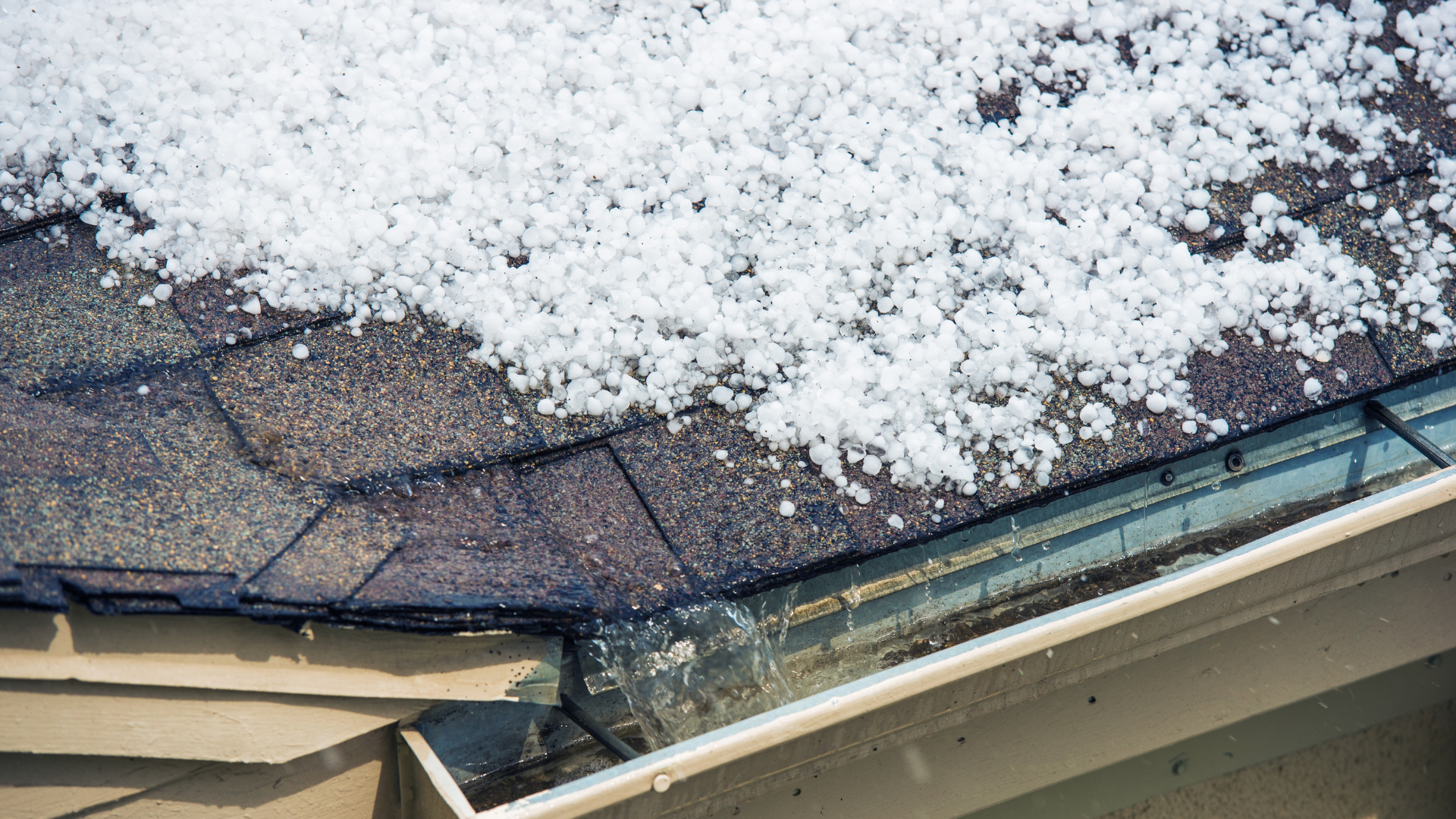
Can Hail Damage a Roof Without Causing Leaks? (Yes — Here\u2019s How)
“But it’s not leaking.” If we had a dollar for every time a North Oaks homeowner said that after a hailstorm, we could pave the Village Center parking lot in Class 4 shingles. It’s the most natural conclusion in the world — no water, no problem — and it’s also the most expensive misunderstanding in Minnesota homeownership. The answer to the question is an emphatic yes: hail routinely inflicts serious, compensable, roof-shortening damage that won’t leak for years. Insurance companies know this, which is why they pay hundreds of millions annually for non-leaking Minnesota roofs. The homeowners who lose are the ones who wait for the drip. Here’s the mechanism, the timeline, and what to do while your options are still open.
What Hail Actually Does to a Shingle
An asphalt shingle is a laminated system: ceramic granules bonded to weatherproof asphalt over a structural fiberglass mat. Its enemy is ultraviolet light — the granules exist mainly as sunscreen for the asphalt, which UV dries, embrittles, and cracks when exposed. A hail strike compromises the system three ways without making a hole: it crushes and displaces granules, opening the asphalt to UV; it bruises the asphalt itself, breaking the granule bond so shedding accelerates around the strike; and — the structural one — it can fracture the fiberglass mat, an invisible crack beneath an intact-looking surface that flexes with every freeze-thaw cycle until it propagates through. None of these leak on day one. All of them guarantee the shingle fails years before its rated life — think of windshield chips that become cracks: the stone strike wasn’t the hole, it was the beginning of one.
The Deterioration Timeline (What Waiting Looks Like)
Year one after impact: nothing visible from the ground; bruises weather gradually; granule loss accelerates at strike points. Years two to three: bare spots emerge where bruises shed; exposed asphalt cracks; mat fractures spread with thermal cycling; the roof “ages” a decade in a couple of Minnesota winters. Years three to five: first leaks — typically at concentrated strike zones, valleys, and penetrations — often blamed on “the roof just getting old.” Meanwhile, the claim window (commonly one to two years in Minnesota policies) has closed, and the deterioration is now legally indistinguishable from wear. The bitter arithmetic: a roof insurance would have replaced for a deductible becomes a $30,000–$45,000 out-of-pocket project in a North Oaks-scale home, plus whatever the eventual leaks cost the interior. The storm did the damage; the calendar did the financial damage.
Why Insurers Pay for Damage That Isn’t Leaking
This surprises homeowners, but it shouldn’t: your policy covers direct physical damage from a covered peril — not “leaks.” Functional hail damage (granule loss exposing asphalt, mat fractures, compromised shingle integrity) is the covered loss, because it measurably shortened the roof’s life on the day the storm hit. Adjusters are trained to identify exactly this: their test squares count bruises per 100 square feet against thresholds, and settlements replace roofs that might not have leaked for another five years. That’s the system working as designed — insurance restoring what the storm took, which was years of roof life. Declining to inspect because “it’s not leaking” is effectively donating your covered loss back to the carrier — a generosity no adjuster will talk you out of.
The Right Response After Any Hail Event
The playbook is simple and mostly free. Within days: photograph ground-level evidence (dented gutters, screens, AC fins — the proxies from our hail identification guide). Within two weeks: professional, photo-documented inspection — Owl Roofing’s Wise Check exists precisely for this, free, with straight answers either direction. If functional damage exists: file while evidence is fresh and the window is open, with your inspection report doing the arguing. If it doesn’t: keep the dated report — it’s the baseline that strengthens your position after the next storm, which in Ramsey County is a matter of when. What we’d caution against equally: the wait-for-a-leak strategy, and the opposite failure mode of signing with whatever storm-chaser knocks first (our contractor guide covers that filter). Between those ditches is a calm, documented, local process that takes an afternoon.
The Questions That Decide “Functional vs. Cosmetic”
Because non-leaking damage is the norm, most hail claims turn on a single distinction: functional damage (shortens roof life, compensable) versus cosmetic (appearance only, often excluded). Knowing how the line is drawn protects you in both directions. Functional evidence includes granule loss exposing asphalt (the UV shield is breached), bruises soft to the touch (the asphalt bond is broken), any mat fracture (structural), and damaged seals or lifted tabs (wind’s contribution). Genuinely cosmetic examples: minor granule scuffing without exposure, and dents in metal components that still shed water — though note that dented soft metals simultaneously serve as evidence of impact energy even where they aren’t themselves the payable loss. Two practical implications: first, insist your inspection distinguishes these explicitly, slope by slope, because a report that just says “damage everywhere” invites an adjuster to say “cosmetic everywhere”; second, understand that shingle age shifts the boundary — the same stone that bounces off a five-year-old Class 4 shingle functionally wounds a brittle eighteen-year-old one, which is why identical storms total some roofs on a street and spare others. An honest local inspection navigates exactly these distinctions — and tells you plainly when your damage genuinely is cosmetic and a claim isn’t warranted. That answer exists too, and you deserve it straight.
The roof kept the water out today — good. Whether it can keep doing so for the next fifteen years is the question the storm actually raised, and it deserves a documented answer.
Waiting for the drip is the one strategy guaranteed to cost more than either answer to that question. Bruised shingles never heal; claim windows never reopen; and the inspection that settles it costs exactly nothing. If hail crossed your part of Ramsey County this season, put the question to rest this week — your future self, staring at a ceiling stain in 2029 with no claim window in sight, will be glad you did.
Frequently Asked Questions
Can hail damage a roof without causing leaks?
Yes — that’s the standard case. Hail bruises granule coverage, asphalt, and fiberglass mats, shortening roof life dramatically while producing no leaks for two to five years. The damage is real and typically insurance-compensable immediately.
Will insurance pay for hail damage if my roof doesn’t leak?
Yes, when damage is functional — policies cover direct physical damage from the storm, not just resulting leaks. Adjusters assess bruise density per test square, and non-leaking roofs are replaced through claims constantly in Minnesota.
How long after hail does a roof start leaking?
Commonly two to five years, as bruised areas shed granules, crack from UV exposure, and mat fractures propagate through freeze-thaw cycles — usually after claim windows close.
Should I get my roof inspected even if everything seems fine?
After any storm with hail near an inch, yes — within two weeks ideally. A free documented inspection either starts a strong claim or creates a dated baseline protecting future ones. Both outcomes have value; wondering has none.
Had hail this season? The clock’s running whether or not the ceiling is. Free Wise Check: book here or (651) 977-6027.
